
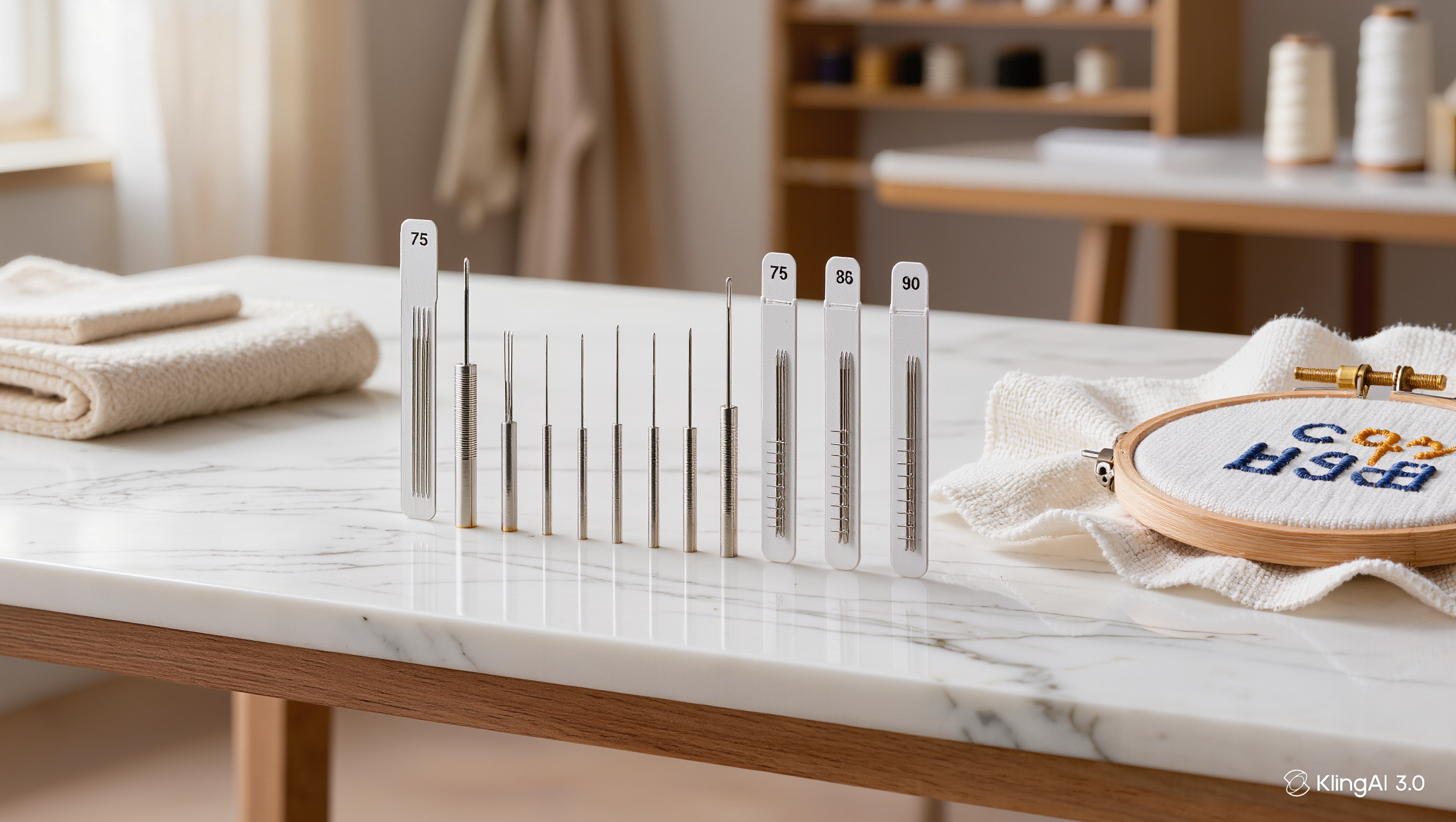
Embroidery machine needle size tells you how thick the needle is — the higher the number, the thicker the needle. Choosing the wrong size is the single most common cause of thread breakage, needle snapping, and fabric damage. Getting it right eliminates most of these problems before they start.
What does needle size mean?
Embroidery machine needles are labelled with two numbers, for example 80/12. The first number is the metric size, which indicates the needle diameter in hundredths of a millimetre. A size 80 needle has a shaft diameter of 0.80 mm. The second number is the Singer system — a historical classification still printed on most needle packaging.
The simple rule: smaller number = finer needle, larger number = thicker needle. Fine needle for lightweight fabric, thick needle for heavy fabric.
Needle sizes and their applications
| Size | Fabric type | Typical use |
|---|---|---|
| 65/9 | Very fine, sheer | Silk, organza, tulle — rarely needed |
| 70/10 | Lightweight | Fine knit, chiffon, thin viscose |
| 75/11 | Medium-light | Cotton, thin polyester, standard t-shirt |
| 80/12 | Medium | Most common size — works with most fabrics and 30-weight thread |
| 90/14 | Medium-heavy | Denim, canvas, heavy cotton, fleece |
| 100/16 | Heavy | Heavy denim, thick canvas, leather, faux leather |
| 110/18 | Very heavy | Multi-layer or very stiff materials — specialist use |
In most commercial embroidery workshops, the vast majority of daily production is handled with 75/11 and 80/12. These two sizes are fully compatible with 30-weight embroidery thread, the most common weight in Turkey, and cover most medium-weight fabrics without issue.
Thread weight and needle size compatibility
Needle size and thread weight are directly linked. If the thread is too thick for the needle eye, friction causes it to break. If the eye is too large for the thread, stitches will be loose and uneven. The general compatibility chart is as follows:
| Thread weight | Recommended needle size |
|---|---|
| 60-weight (fine) | 70/10 or 75/11 |
| 30-weight (most common in Turkey) | 80/12 or 90/14 |
| 40-weight (fine detail work) | 75/11 or 80/12 |
| Metallic / sim thread | 80/12 or 90/14 — metallic needle tip recommended |
For metallic thread, the inside of the needle eye must be smooth and polished. A needle designed for metallic thread has a longer eye and a specially finished groove that dramatically reduces breakage compared to a standard needle.
Needle systems by machine brand
Not all embroidery machines use the same needle system. Installing the wrong system needle can damage the machine.
- Commercial machines — Brother, Tajima, ZSK, Barudan, Happy, SWF → 134R (DBxK5) system
- Home embroidery machines — Brother, Janome, Singer, Bernina → 130/705H system
- Some Pfaff models → manufacturer-specific system — always check the manual
Your machine manual will state which needle system it requires. If you are unsure, check our machine needles page or ask us directly on WhatsApp.
Not sure which needle size is right for your machine and thread? Ask us — we'll point you in the right direction.
Ask on WhatsAppCommon mistakes to avoid
- Using one size for everything: 80/12 covers most work, but moving to denim or canvas requires a 90/14. Staying on the wrong size causes both needle breakage and poor stitch quality
- Installing the needle incorrectly: The flat side of the needle shank must face the back. A needle that is not fully seated is one of the most frequent causes of snapping
- Continuing with a dull needle: The needle tip dulls invisibly. Replace it every 8–10 hours of stitching or at the start of each new project
- Pulling the fabric during stitching: Never guide or pull the hoop while the machine is running. The machine moves the fabric; your hands should stay clear
- Using a standard needle with metallic thread: Switch to a metallic-tip needle when using sim or metallic thread — breakage drops significantly
When to replace the needle
Signs that a needle needs replacing: thread breaks more often than usual, the needle leaves visible puncture marks on the fabric, the stitching sound is heavier or different from normal, or you can see a burr on the tip under magnification. When any of these appear, replace immediately. General rule: every 8–10 hours of run time.
Summary
Needle size selection is straightforward once you know the logic: fine fabric needs a small number, heavy fabric needs a large number. Match the needle to the thread weight, replace on schedule, and make sure installation is correct. These three steps resolve the large majority of thread breakage and needle breakage problems that embroidery workshops encounter.