
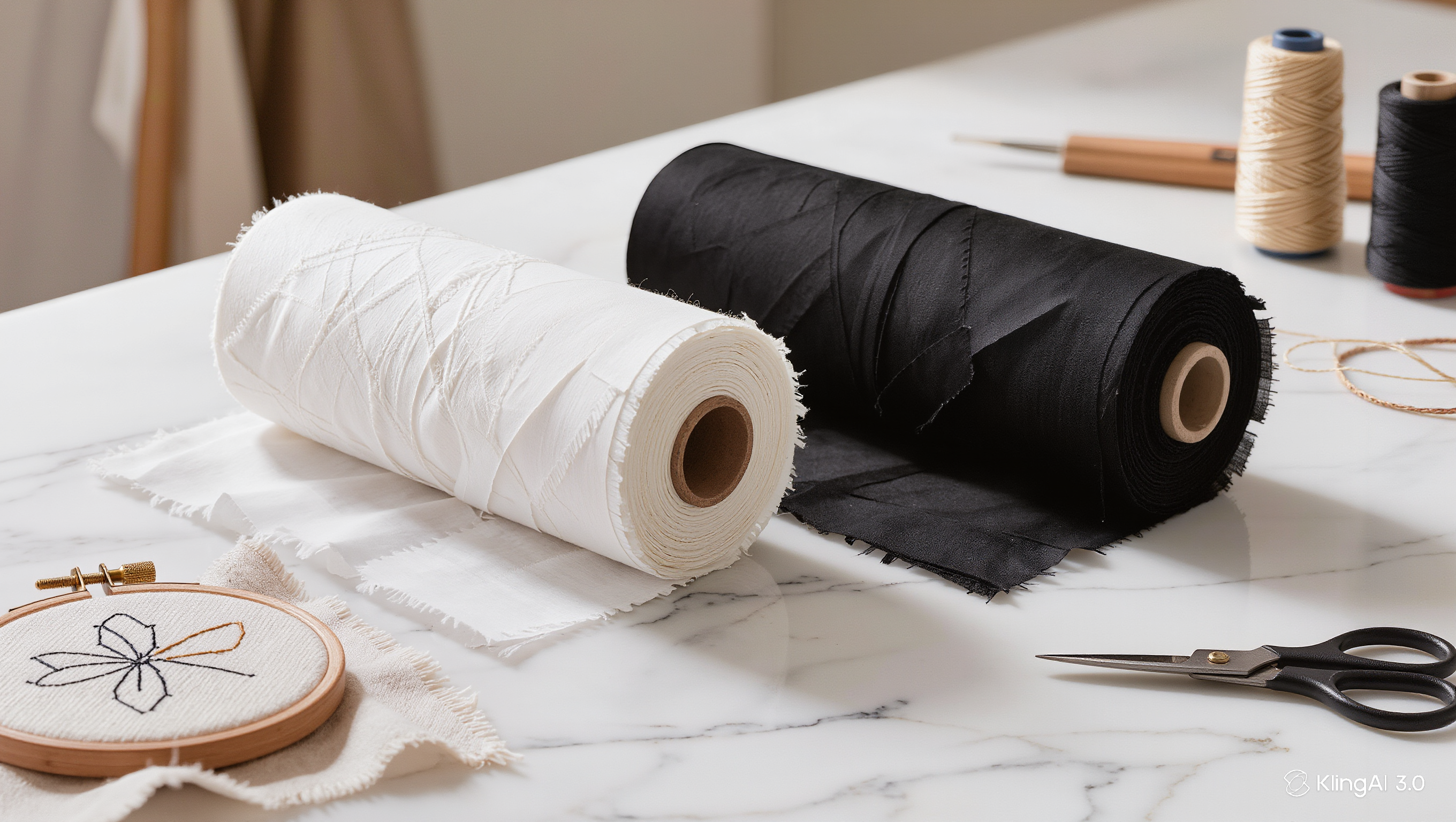
One of the most common material mistakes in embroidery is using tear-away and cut-away stabilizer interchangeably. Both go under the hoop, both stabilize the fabric — but use the wrong one and the design falls apart within a few washes. This guide makes the difference clear once and for all.
The core logic of each type
Tear-away stabilizer is removed completely by hand after stitching. Nothing stays behind. It relies on the fabric itself being stable enough to hold the design's shape without help.
Cut-away stabilizer is trimmed with scissors after stitching, and the portion under the design stays in the garment permanently. Stretchy fabric moves with every wash and wear; the remaining stabilizer shields the stitches from that movement for the garment's lifetime.
So the real question is simple: does your fabric stretch, or not?
Comparison table
| Feature | Tear-Away | Cut-Away |
|---|---|---|
| Removal | Torn off by hand, fully removed | Trimmed with scissors, backing stays in |
| Best fabrics | Wovens, canvas, denim, towels, caps | Knits, t-shirts, fleece, stretch fabrics |
| Permanent support | None — fabric is stable on its own | Yes — protects through washing and wear |
| Production speed | Fast — suited to high volume | Slower — trimming takes labor |
| Cost | Usually more economical | Slightly higher |
| Risk if misused | Design distorts on stretchy fabric | Can show through on thin wovens |
Which fabric gets which stabilizer?
Use tear-away for:
- Denim and canvas — the fabric is already firm; no permanent backing needed
- Towels and bathrobes — leftover backing would feel stiff; tear-away keeps them soft
- Caps and bags — structured items where speed matters in production runs
- Woven shirting — stable weave holds the design shape after removal
Use cut-away for:
- T-shirts and knits — stretchy loops need permanent support, no exceptions
- Fleece and sweatshirts — prevents designs sinking into soft, unstable surfaces
- Performance and stretch fabrics — elasticity is the single biggest threat to stitch integrity
- Baby and children's wear — frequent washing demands lasting reinforcement
Unsure about a fabric? Do the two-hand test: pull it gently. If it visibly stretches, use cut-away; if it doesn't, tear-away is fine. And for freestanding lace or appliqué work, neither is the answer — that's a job for water-soluble stabilizer.
Not sure which stabilizer suits your fabric? Send us a photo on WhatsApp — we'll point you to the right type and weight.
Ask on WhatsAppCommon mistakes to avoid
- Using tear-away on t-shirts: The most frequent error in the trade. It looks fine at first — then after 5-10 washes the design puckers and ripples permanently
- Tearing in one big pull: Ripping large sections tugs and loosens the stitches. Tear in small pieces, supporting the stitch line with your other hand
- Trimming cut-away flush to the stitches: Leave at least 5 mm (1/4 inch) of margin; trimming to zero reduces support and risks nicking the fabric
- Relying on a single layer: Dense, high-stitch-count logos may need two layers of tear-away or a heavier-weight cut-away
- Ignoring stabilizer weight: Heavy backing on light fabric feels boardy; light backing on heavy fabric gives insufficient support
A practical rule for workshops
Decide the fabric first, then the stabilizer — never the other way around. Keeping cut-away stocked for knitwear jobs and tear-away for caps, bags and woven goods covers roughly 90% of commercial work. For unfamiliar fabrics, run a 10-minute test stitch on a sample before starting the production run; it is the cheapest insurance against a batch of ruined garments.
Summary
Tear-away is the stabilizer for stable fabrics; cut-away is the stabilizer for stretchy ones. The deciding factor is a single question: does the fabric stretch? Choose correctly and the design keeps its shape for years — choose wrong and even the finest thread cannot save the result. For a broader overview of every stabilizer type, see our stabilizer selection guide.